Have You Noticed Small White Spots on Your Arms or Legs? Here’s What They May Be
Have you ever looked closely at your arms or legs and noticed tiny white or lighter-colored spots that seem to appear out of nowhere?
These spots are fairly common, especially on areas that receive regular sun exposure. But the important thing to know is that small white spots can have several different causes—and a photo alone is not enough to make a definite diagnosis.
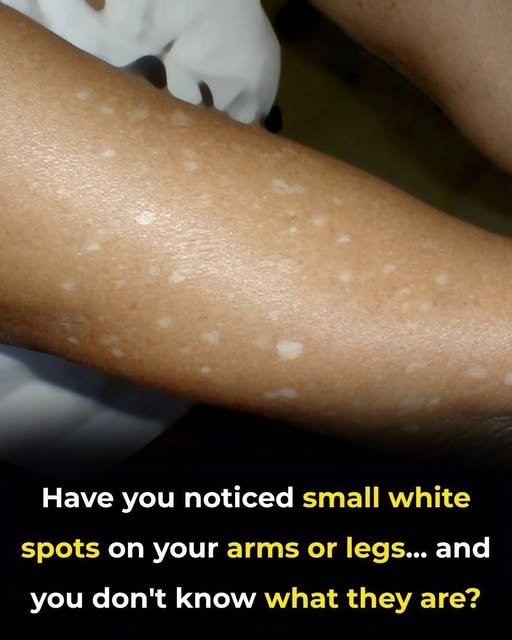
One possibility that closely matches the appearance of multiple small, flat white spots on the arms or legs is idiopathic guttate hypomelanosis (IGH). DermNet®
🌿 What Is Idiopathic Guttate Hypomelanosis?
Idiopathic guttate hypomelanosis is a common, benign pigment condition in which small areas of skin lose some or all of their normal pigment.
The spots are typically:
Small and flat
Pale or porcelain-white
Round, oval, or irregularly shaped
Usually not painful
Usually not itchy
Common on the forearms and lower legs
More noticeable on darker or tanned skin
DermNet notes that the spots are often only a few millimeters across and commonly occur on sun-exposed limbs. DermNet®
Over time, some people develop more spots, particularly with increasing age and cumulative sun exposure.
☀️ Is the Sun Responsible?
Sun exposure appears to be one factor associated with IGH, although the exact cause is not completely understood.
Researchers believe that a combination of skin aging, chronic sun exposure, genetic factors, and possibly minor skin injury may contribute. DermNet®
This is one reason these spots can become more noticeable as the years go by.
But White Spots Aren’t Always IGH
This is where it gets important.
Similar-looking spots can occur with several other skin conditions.
1. Vitiligo
Vitiligo occurs when pigment-producing cells are destroyed, resulting in areas of lighter or completely white skin.
It can occur on the hands, arms, legs, face and many other areas. The patches can gradually become larger or appear in additional locations. Académie américaine de dermatologie
2. Tinea Versicolor
Tinea versicolor is caused by an overgrowth of yeast that normally lives on the skin.
It can produce lighter or darker patches and may sometimes have fine scaling or itching. It is particularly common in warm, humid climates. Académie américaine de dermatologie
3. Post-inflammatory Hypopigmentation
Sometimes skin becomes lighter after inflammation, irritation, an injury, a rash, or another skin condition has healed.
The American Academy of Dermatology notes that lighter areas can have many causes, so proper diagnosis matters. Académie américaine de dermatologie
🔎 How Can You Tell the Difference?
Unfortunately, there isn’t a reliable home test that can identify the cause simply by looking at a photograph.
A dermatologist may examine the pattern, borders, texture and distribution of the spots. Depending on the situation, they may also use a Wood’s lamp or other examination methods to help distinguish conditions such as vitiligo and tinea versicolor. Académie américaine de dermatologie
For example, IGH tends to produce small, discrete spots on sun-exposed arms and legs, while vitiligo can produce larger or progressively expanding areas of pigment loss. Tinea versicolor is more likely to have fine scaling and often affects areas such as the trunk. DermNet®
🧴 What Can You Do?
If the spots are stable, small and not causing symptoms, they may not require treatment—particularly if they turn out to be IGH, which is considered benign. DermNet®
A few sensible skin-care steps include:
☀️ Protect your skin from the sun Use a broad-spectrum sunscreen and protect exposed arms and legs when spending significant time outdoors.
🧴 Keep your skin moisturized A simple fragrance-free moisturizer can help maintain the skin barrier.
🚫 Don’t scrub aggressively Scrubbing, bleaching products, lemon juice, baking soda or other harsh DIY treatments can irritate the skin and potentially make pigmentation changes more noticeable.
👩⚕️ Get an evaluation if the spots are changing Especially if they’re spreading, becoming completely white, developing scale or itching, or appearing in new areas.
🚨 When Should You See a Dermatologist?
Consider getting the spots checked if:
They are rapidly increasing
Individual spots are getting larger
They become itchy, scaly, painful or inflamed
You notice larger white patches
The spots are appearing on several different areas of the body
You aren’t sure whether they are vitiligo, fungal infection or another condition
A dermatologist can usually narrow down the cause through a physical examination and, when necessary, additional testing. Académie américaine de dermatologie
The Bottom Line
Small white spots on the arms or legs don’t automatically mean a vitamin deficiency, and they don’t automatically mean vitiligo.
The pattern in this image could resemble idiopathic guttate hypomelanosis, but a photograph cannot confirm that diagnosis. Other conditions—including vitiligo, tinea versicolor and post-inflammatory pigment loss—can look similar.
If you’ve noticed these spots on your own skin, paying attention to their size, location, texture and whether they’re changing over time can be helpful when discussing them with a dermatologist.
Have you ever noticed these small white spots on your arms or legs? Did they stay the same, or did they become more noticeable over time? 👇
This information is for general educational purposes and is not a diagnosis.