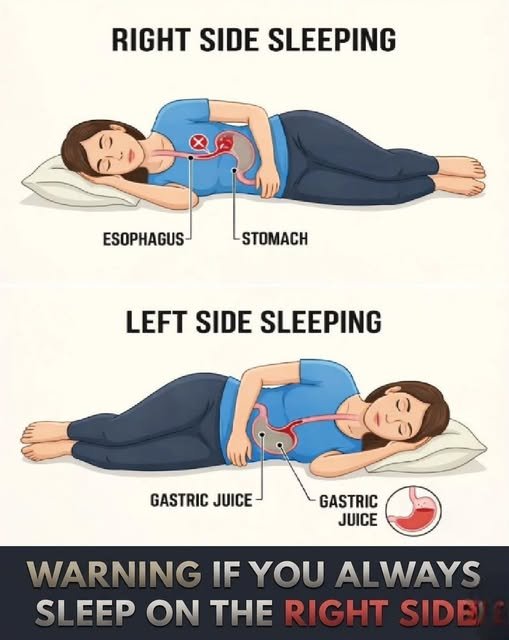
A viral image warns people that sleeping on the right side is harmful and suggests that everyone should sleep on the left side.
There is an important truth behind the image—but the claim is too broad.
For people who experience nighttime acid reflux or GERD, sleeping on the left side may reduce reflux compared with sleeping on the right side. But sleeping on your right side is not inherently dangerous for everyone.PubMed
🛏️ Why Can Sleeping Position Affect Reflux?
Your stomach and esophagus have a particular anatomical relationship. When you lie down, gravity no longer helps keep stomach contents in the stomach as effectively as when you’re upright.
For people prone to reflux, body position can therefore make a difference.
Research and recent reviews support left-side sleeping as a useful lifestyle measure for nighttime GERD symptoms. PubMed
👈 Why Might the Left Side Help?
When you’re lying on your left side, the position of the stomach can make it less likely for gastric contents to move upward toward the esophagus.
This is why left-lateral sleeping is often recommended for people with nighttime reflux.
It doesn’t mean that stomach acid can never reach the esophagus while you’re on your left side—only that the position can reduce the likelihood or duration of reflux episodes in people who are susceptible.
👉 What Happens When You Sleep on the Right Side?
For some people with GERD, right-side sleeping can make nighttime reflux symptoms worse.
That doesn’t mean the right side is damaging your stomach or esophagus every night. It simply means that if you already have reflux, changing position may help control symptoms.
So the viral image’s message should be changed from:
“Never sleep on your right side.”
to:
“If you have nighttime acid reflux, try sleeping on your left side.”
That’s much closer to the evidence.
🍽️ Another Important Habit: Don’t Eat Right Before Bed
A purpose-designed wedge is generally more practical than simply stacking several pillows, because pillows alone can bend the body in a way that isn’t as effective.
🌶️ Pay Attention to Your Personal Triggers
Common foods and drinks associated with worsening GERD symptoms include:
Occasional heartburn is common, but frequent or persistent reflux deserves attention.
Speak with a healthcare professional if you regularly experience:
Heartburn several times a week
Difficulty or pain when swallowing
Persistent vomiting
Unexplained weight loss
Persistent chest discomfort
Symptoms that aren’t improving with lifestyle measures or appropriate treatment
And chest pain should never automatically be assumed to be acid reflux, especially if it is severe, new, or accompanied by shortness of breath, sweating, nausea, or pain spreading to the arm, jaw or back.
The Bottom Line
Sleeping on your left side may be helpful if you suffer from nighttime acid reflux. But there’s no evidence that simply sleeping on your right side is dangerous for otherwise healthy people.
If reflux bothers you at night, try combining left-side sleeping + finishing meals at least 3 hours before bed + elevating your upper body. These measures can complement medical treatment when needed. PubMed
This article is for educational purposes and does not diagnose or treat GERD.