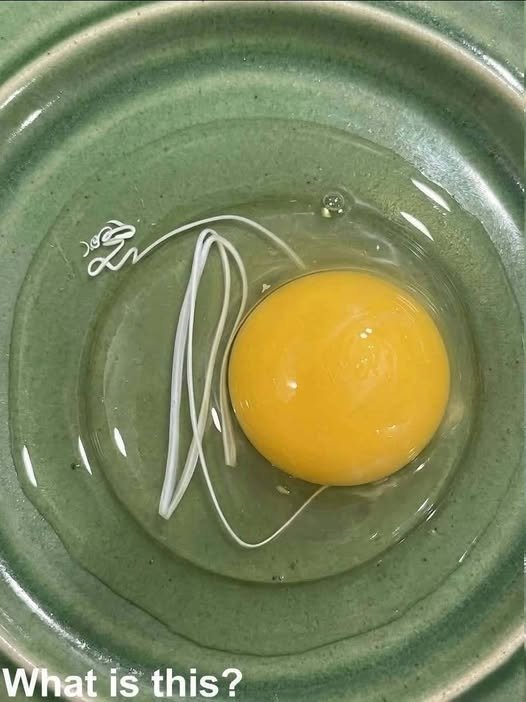
If you crack an egg and find a strange white, ribbon-like or stringy structure attached to the yolk, there’s usually no reason to panic.
That white strand is called the chalaza (pronounced kuh-LAY-zuh), and it is a completely natural part of an egg.
What Is a Chalaza?
The chalaza is a twisted strand of thickened egg white that helps anchor the yolk in the center of the egg. Eggs normally have chalazae, although they can be more noticeable in some eggs than others. (Ask USDA)
It can look surprisingly unusual—especially when the egg is cracked onto a plate and the strand becomes stretched out.
Is It a Worm or Parasite?
No. A normal chalaza is not a worm, embryo, or parasite. It is simply part of the egg’s natural structure.
The more prominent the chalaza appears, the fresher the egg may be. As eggs age, the thick egg white becomes thinner and the chalazae can become less noticeable. (Ask USDA)
Can You Eat It?
Yes. The chalaza is edible and does not need to be removed. It can simply be cooked along with the rest of the egg.
For food safety, however, the USDA recommends cooking eggs thoroughly rather than eating raw or undercooked eggs. (Ask USDA)
When Should You Throw the Egg Away?
The string itself isn’t a reason to discard an egg. However, don’t use an egg if it has an unusual foul odor or abnormal pink, iridescent, or otherwise suspicious discoloration, which can indicate spoilage. (Ask USDA)
So the next time you crack an egg and see that mysterious white string, you can relax:
It isn’t a worm—it is the chalaza, a normal part of the egg. 🥚